Spiritual Marketing Ick
Something always felt off to me. I’d watch spiritual teachers advertise their courses and run webinar funnels with countdown timers. Only 3 spots left. Doors close in 2 hours. The same scarcity. Cluttered landing pages with theatrical slashed prices. Headlines built to grab attention I’ve come to associate with “marketing.”
That’s when the question started to form: if we teach abundance, why do we sell with scarcity?
I always wanted to start a business. I told myself I would when I had something worth sharing.
Then I found out I was having a kid. I’m American, in love with a UK woman. Citizenship is not simple. Remote work was the only open door. So I walked through it. I always go into the heart, the seat of all knowing. I listened. I trusted. I took it as the push I needed. Otherwise I’d plan forever.
I started with the new marketing books. Seth Godin. Russell Brunson. Alex Hormozi. The books said people buy to relieve pain. Fear of being unsafe. Unloved (Prescription Drugs, Gun ads, Tinder). Or the desire to climb above others in status (think Gucci, Rolex, Porche). They all pointed back to a pyramid drawn by a man named Maslow. A supposed hierarchy of needs. Climb up from the primitive ones to the higher ones.
I didn’t have a high opinion of it.
The question I kept coming back to: what pain does a kid solve when they want a Spider-Man action figure? When they throw a tantrum in the middle of the store for clay-dough? Clearly not everything fits the pain-relief model. What pain do the original Apple campaigns solve? Their ads use Da Vinci, Einstein, the bitten apple. They appeal to creativity. Not pain.
Marketing aimed at lack has always made me feel manipulated. It’s the quickest way to make me want nothing to do with a product. Again — I trust the heart.
So I went deeper. Bernays. Ogilvy. Gary Halbert. The old masters of selling. Every road went back to the pyramid.
The Pyramid That Never Was
Every marketing book shows the same drawing. A pyramid. At the bottom: food, safety, sex. In the middle: love, belonging, status. At the top: self-actualization. The pyramid says: poke people’s wound. Remind them they’re unsafe. Offer them security. They’ll buy. Self actualization is only for those who have moved past the base needs to the top of the pyramid.
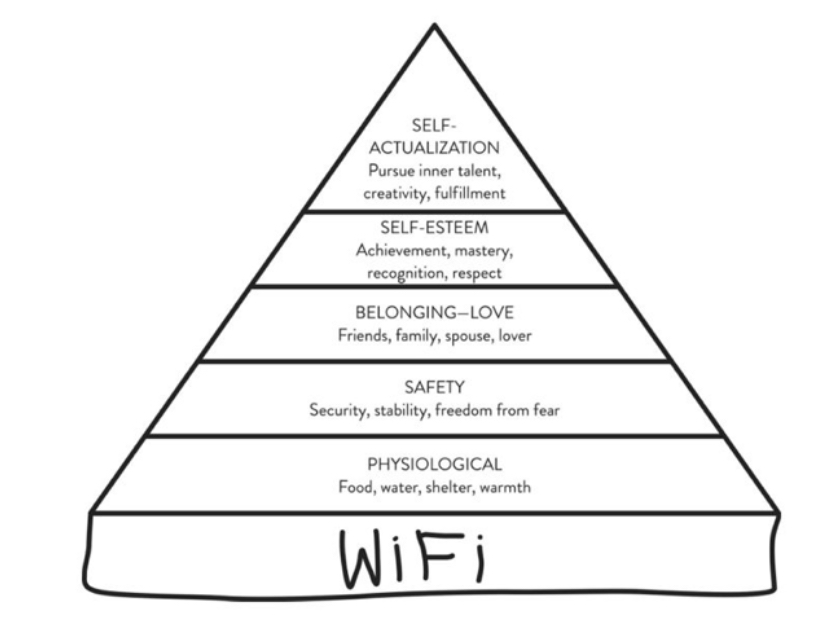
But Maslow never drew the pyramid.
Todd Bridgman and his colleagues examined in detail how the pyramid came to be and concluded that “Maslow’s Pyramid” was actually created by a management consultant in the sixties. From there, it quickly became popular in the emerging field of organization behavior. Bridgman and his colleagues note that the pyramid resonated with the “prevailing (post-war) ideologies of individualism, nationalism and capitalism in America and justified a growing managerialism in bureaucratic (i.e., layered triangular) formats.”
— Scott Barry Kaufman P.H.D., Transcend
Maslow concluded later in life that the needs all run at the same time. They feed each other.
After his heart attack, doctors gave him a few years left. He went on writing despite being on a timer. His self-actualization superseded his immediate health threats. In those last years he got tired of the term self-actualization. He started using a better phrase: becoming fully human.
A Boat, Not a Pyramid
Psychologist Scott Barry Kaufman picked up Maslow’s work and his later notes giving us a better idea of Maslow’s original vision.
Imagine a sailboat.
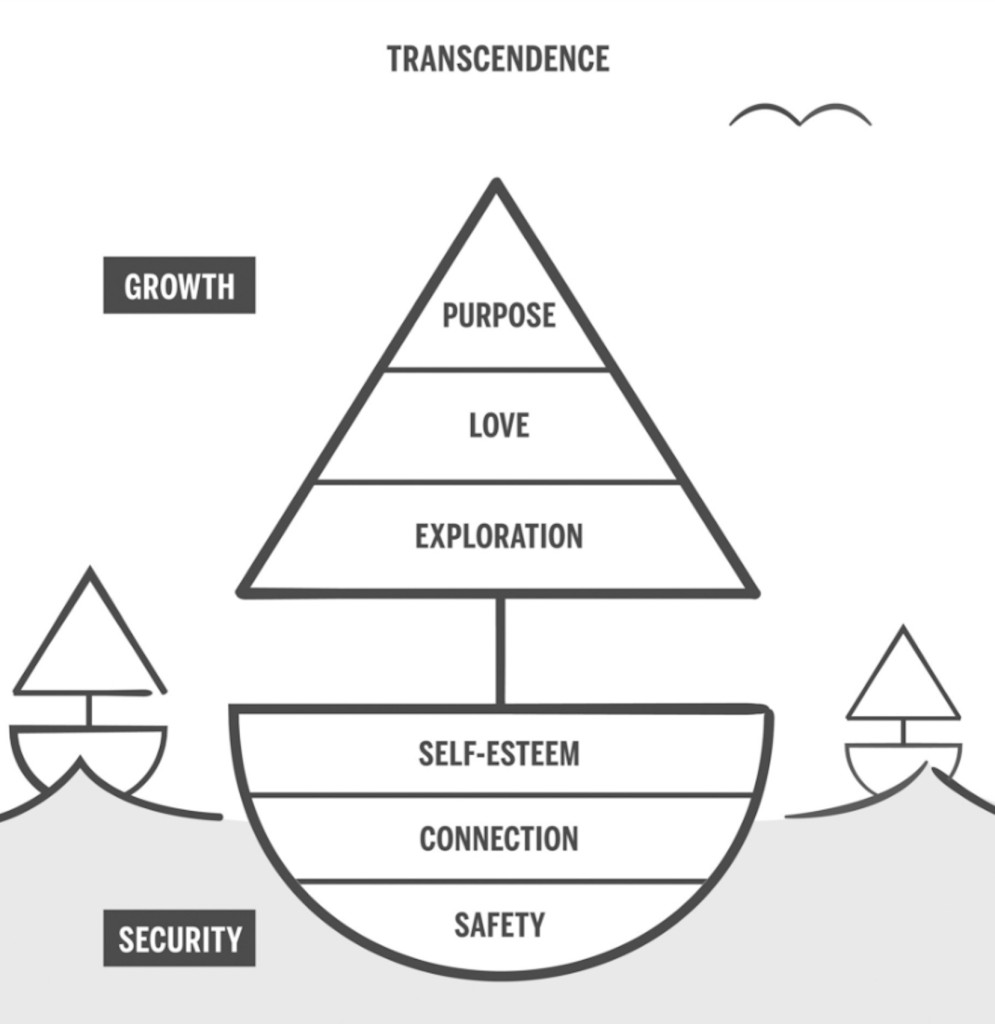
The hull keeps you afloat. Safety. Food. Shelter. Belonging. Without it, you sink.
The sail catches the wind. Exploration. Love. Purpose. The pull to become more.
You need both. A boat with no sail just drifts. A sail with no hull just drowns.
The needs aren’t a ladder you climb by stepping on others. They’re a vessel you build, and every part works in tandem. Security without self-actualization is empty. Self-actualization without safety is ungrounded.
When we sell fear without actually solving it, we punch holes in other people’s hulls and sell them buckets. We trap them. We keep them too busy bailing water to ever raise a sail.
Twin Impulses
Children can see who is unfair and they also pay attention to status. The two seem at odds, fairness is to treat others well, status is to rise above them. The fairness piece is wired in early. Researchers showed babies between six and ten months old a simple puppet show. A square helped a ball up a hill. A triangle pushed it back down. When the babies were given both puppets to play with, almost all of them chose the helper. They couldn’t yet speak. They already knew. Selflessness reads as good. Cruelty reads as wrong. Across sixty cultures, the same moral instincts show up: help your group, be fair, return favors, don’t steal.
The status piece is just as old. Even crickets keep a tally of who’s rising or falling. Ravens listen in on the gossip of nearby flocks and pay closer attention when the gossip is about a fall in another bird’s standing. Status is a real human need. The question isn’t whether we want it. The question is what we have to do to get it. What raises our status often has friction with what is selfless. But what if prestige is the natural result of fairness?
What the Blackfoot Knew
Maslow’s theory emerged after he visited the Northern Blackfoot reserve in Alberta in the summer of 1938. He sat with them. He studied them. They changed how he saw human nature.
In the Blackfoot tribe, prestige didn’t come from holding wealth. It came from giving it away.
The most respected people circulated abundance through the tribe. They threw the biggest feasts. They gave the best gifts. They lifted others up. It wasn’t who won or dominated. To hold wealth and not share it wasn’t even on the map of prestige. The idea didn’t register.
Maslow couldn’t ignore what he found. Eighty to ninety percent of the Blackfoot tested as emotionally secure as the most secure five to ten percent of Americans. Crime was almost gone. Violence amounted to the occasional fistfight between young men who’d been drinking. Financial jealousy and greed weren’t part of daily life. When tension rose between people, humor put it back down before it could build into harm.
The Blackfoot weren’t perfect. People with mental illness got cast out. Roles were fixed. This isn’t tribe good, capitalism bad. Many tribes are as broken as us, or more so. The Blackfoot are one example of a coherent system that worked. One system not built on scarcity. Prestige was reserved for those who generated abundance for the tribe — those whose role created safety and self-actualization for others rather than feeding off of it or undercutting it.
The Clog (Coda)
The systems we’ve built pulls people toward holding. But the system is perpetuated by each of us. A healthy body circulates. Moves nutrients. The cells get fed. The blood returns.
A sick body clogs. Blood pools. Tissue starves. Cells die. That kind of clog is called a heart attack. This is what happens when currency can’t circulate. Wealth piles up at the top. Never flows back down. The cells at the bottom starve. People can’t breathe. Crime rises. Trust drops. Everyone feels it. Even the people sitting on the clog. Because they bought into this idea that prestige means a bigger door and a moat — and they feel all the more disconnected and alone because of it.
The word courage comes from the Latin cor. It means heart.
To circulate when the system rewards holding takes heart. To open instead of close the fist takes heart. Maslow believed people were innately good but compensated in their confusion to try and meet the needs they were deprived of.
Maslow’s heart attack didn’t take him. His heart was in his work.